

Students take part in a veterinary pharmacy lab demonstration in Beard Hall. (Danny Alexander/UNC-Chapel Hill)
Stephanie Kiser ’92 led rural health programming at the UNC Eshelman School of Pharmacy for more than a decade. But she was a rural resident long before that, one of just 87 students in her high school class in Sampson County, where there were “more livestock than people,” she joked.
It wasn’t until a pharmacist visited her school’s career fair that she considered the profession.
“She talked about how she loved giving back to her community and how this really fed her,” said Kiser. “That is what sparked my interest.”
Her colleague Wendy Cox ’98 (PharmD), the pharmacy school’s associate dean for admissions and accreditation, grew up in neighboring Robeson County — in St. Pauls, North Carolina, population just over 2,000.
“I worked in an independent pharmacy when I was in high school and was inspired by the pharmacist who was a UNC grad,” said Cox. “I saw firsthand the impact he made in the community.”
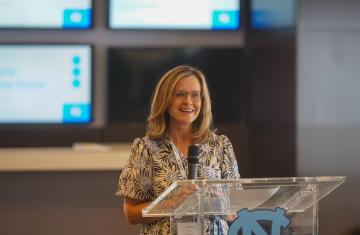
Over 20 years later, Cox is inspiring the same young professionals she and Kiser once were. This summer she launched the pharmacy school’s Rx-IMPACT program, for which she serves as principal investigator with Kiser partnering as co-investigator.
The initiative, supported by the McKesson Foundation, will recruit students from rural and medically underserved areas of the state in the hope they’ll return and relieve healthcare shortages.
From Chapel Hill to local communities
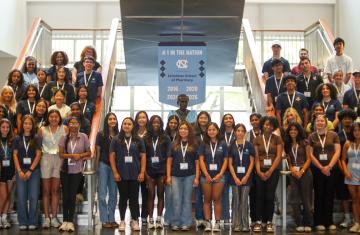
The program kicked off in June with a two-day camp for high school students and a three-day camp for college students on the Carolina campus.
Anna Valentina Corona Cruz, a first-year transfer student at UNC Asheville, has wanted to be a pharmacist since she was a teenager. At the camp, she learned how to take blood pressure, provide a vaccine and administer Naloxone, a drug that helps reverse opioid overdoses. She also took part in a group project researching how rural county residents could better access healthcare.
“The program really opened my eyes to just how underserved a lot of communities are,” said Corona Cruz. “Getting to see just how much a pharmacist can make an impact on people’s lives is really meaningful.”
The camp also introduced participants to a potential career path. Heer Bhagat, a high school junior from Rockingham, North Carolina, was intrigued by the many professions within pharmacy, which combines her interests in biology and chemistry.
“One of the main parts I loved was meeting other peers that came from the same background as me who were also interested in the same things,” said Heer. “I was making connections and friends with similar interests.”
Serving a dual purpose
The rest of the yearlong program will focus on networking and shadowing opportunities. Part of the grant funds internships for current PharmD students, who will serve as mentors to program participants.
Rx-IMPACT spans several programs at the school that inspire and prepare students to serve rural areas.
Since 90% of the U.S. population lives within five miles of a pharmacy, Cox said, “we know pharmacists are accessible, and we know that they can improve health in their local communities. We want to help students see the type of impact that pharmacists can have and hopefully inspire them to go back and serve those patient populations.”
The Rx-IMPACT program is funded through a three-year grant awarded to the UNC Eshelman School of Pharmacy by the McKesson Foundation. The program is free to all participants.
Originally published by University Communications and Marketing.